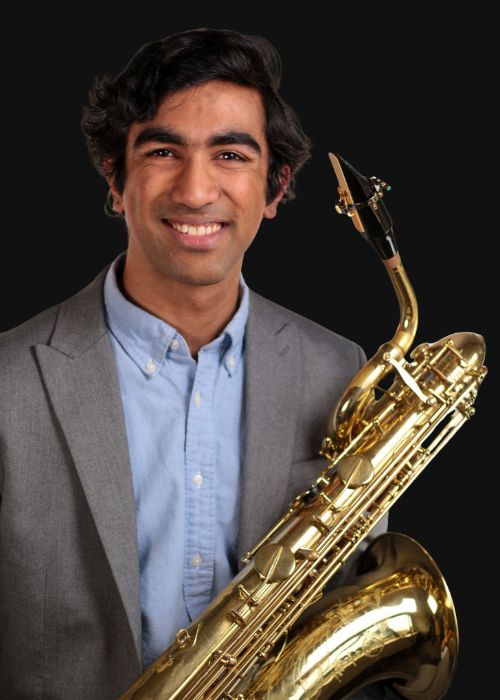
Through creative programming and innovative collaborations, Uday Singh is dedicated to offering new artistic experiences to diverse audiences.
His wide-ranging activities — spanning performance, pedagogy, and cultural administration — reflect his deep commitment to promoting contemporary music.
Uday Singh has carried out numerous artistic projects on international stages.
In Switzerland, his recent solo project “In Transit” explores physical and temporal journeys through staging, lighting design, and non-classical musical idioms, offering an accessible and immersive approach.
He was also Associate Creative Producer for “Heard” by Alarm Will Sound, a work acclaimed at its Carnegie Hall premiere for the finesse with which it weaves personal narratives into a complete musical story.
Dedicated Educator and Trainer
As a teacher, Uday led the Rochester New Horizons Saxophone Ensemble, composed of saxophonists aged 65 to 87, fostering inclusive and intergenerational practice. He also provides private instruction to younger students as a teaching assistant at the Eastman Community Music School.
He currently serves as Assistant Director of the Eastman Saxophone Project, now in its 14th season and recognized as a major institution in the Rochester music scene.
Cultural Administrator and Leader
In parallel, Uday is a member of the editorial and development committees of the North American Saxophone Alliance.
He also serves as Program Coordinator for the contemporary music ensemble Alarm Will Sound, contributing to the promotion of innovative works and the highlighting of emerging composers.
Academic Background and Research
Uday Singh graduated from the Eastman School of Music (Bachelor of Music, 2020) and the Zurich University of the Arts (Master, 2022).
In 2022, he received a Fulbright Fellowship to study the success of contemporary saxophone among Swiss and European audiences.
He is currently pursuing a Doctor of Musical Arts (DMA) at the Eastman School of Music in Rochester, New York, continuing his research on contemporary performance and its cultural impact.










Comments:0